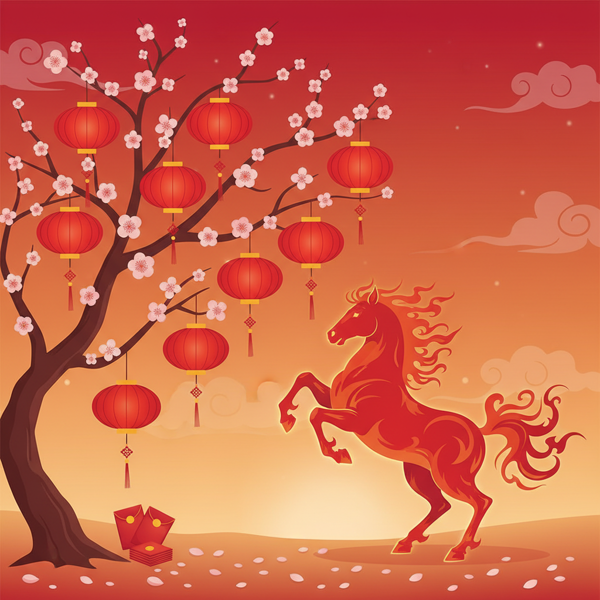
Ready to gallop into a new zodiac year?
Chinese New Year 2026 kicks off on 17 February 2026, and if you check the zodiac, you'll notice this year is ruled by a rather spirited animal. The Fire Horse takes the stage, replacing the Wood Snake of 2025. It's a combination that comes around only once every 60 years, and it has quite a reputation in Chinese astrology.
Mark both 17 and 18 February in the February 2026 calendar, because they're back-to-back federal public holidays across Malaysia.
When exactly is Chinese New Year 2026?
Chinese New Year follows the lunar calendar, so the Gregorian date shifts every year. For 2026, the dates are:
| Day | Date | Description |
|---|---|---|
| Day 1 | Tuesday, 17 February 2026 | New Year's Day (公共假期) |
| Day 2 | Wednesday, 18 February 2026 | Second day of the new year |
Both days are federal public holidays in Malaysia, which means every state and federal territory observes them. Sabah and Sarawak sometimes declare additional related days, so Sabah and Sarawak residents should double-check their state calendars.
The celebration traditionally runs for 15 days, from the first day of the lunar month right up to Chap Goh Meh (Lantern Festival) on 3 March 2026.
What does "Year of the Fire Horse" actually mean?
The Chinese zodiac has two parts that work together. The Heavenly Stems (elements) and the Earthly Branches (animals) rotate on a 60-year cycle.
- Animal (Earthly Branch): Horse (午, wǔ)
- Element (Heavenly Stem): Fire, specifically yang fire (丙, bǐng)
- Full name: Bing Wu (丙午), often called the Red Horse or Fire Horse
Horse years are associated with ambition, travel, independence, and action. When you add fire to that, the energy intensifies. Many traditional almanacs describe Fire Horse years as bold, fast-moving, and occasionally turbulent. Whether you believe any of that is up to you, but expect to hear plenty of discussion in the lead-up.
The previous Fire Horse year was 1966. The next one after 2026 will be 2086. Pretty rare company.
How Malaysians celebrate
Chinese New Year in Malaysia blends Chinese tradition with a uniquely local flavour. A few things you'll see everywhere:
- Reunion dinner (团圆饭) on Lunar New Year's Eve, 16 February 2026
- Open houses throughout the 15-day period where friends of all backgrounds are welcomed
- Yee sang (鱼生) tossing, a tradition that originated in Malaysia and Singapore
- Ang pow (红包) for children and unmarried relatives
- Lion dance performances at malls, offices, and temples
- Chap Goh Meh on the 15th day, where tradition has women tossing mandarin oranges into rivers to find love
If you're planning travel home or out of town, book early. The days before Day 1 and the days after Chap Goh Meh are the busiest on Malaysian roads and airports.
What about neighbouring celebrations?
The lunar month around Chinese New Year is packed with connected festivities. A few to watch for in 2026:
- Laba Festival (5 January 2026)
- Kitchen God Festival (10 February 2026), just before Lunar New Year's Eve
- Renri (23 February 2026), the "people's birthday" on day 7
- Chap Goh Meh (3 March 2026)
None of these are gazetted public holidays, but they're culturally observed and often turn up in business greetings and family gatherings.
Planning around the long weekend
Because Day 1 is a Tuesday and Day 2 is a Wednesday, employees who take Monday 16 February off can stretch the break from Saturday all the way to Wednesday. A five-day run with only one day of annual leave. Smart planning, especially if you're balik kampung to a small town or heading abroad.
If your workplace follows a Friday-Saturday weekend (Kedah, Kelantan, or Terengganu), the math is slightly different. You might consider taking Thursday and Sunday to build a similar block.
Use the 2026 calendar to see how Chinese New Year stacks up against your state's public holidays and plan leave accordingly.
One more thing: what the data says
The Chinese calendar on Kalendarnegeri.my is computed using standard astronomical rules. A lunar month starts on the day of the new moon at the 120°E meridian (China Standard Time), which is the traditional reference point. Year pillars follow the ganzhi sexagenary cycle. For more on our data sources, see the about page.
2026 is going to move fast, if the Fire Horse reputation holds up. Lock in your plans early, book that reunion dinner, and remember to wear red. Gong Xi Fa Cai in advance.