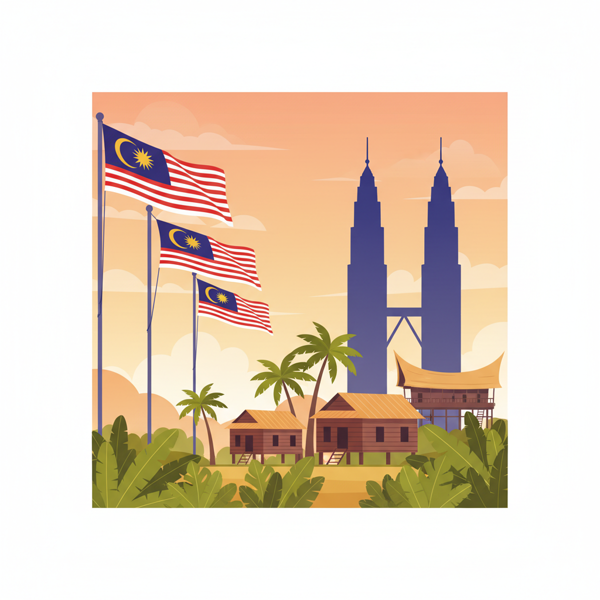
Two national holidays, two weeks apart. Aren't they the same thing?
Honestly, a lot of people get these mixed up, and it's easy to see why. Flags go up across the country in August. They stay up through September. Parades happen on both dates. And the official names sound similar enough that it's tempting to treat them as one long patriotic stretch.
But Hari Kebangsaan (31 August) and Hari Malaysia (16 September) commemorate two genuinely different events, separated by six years of history. Knowing which is which matters, especially if you're teaching kids, planning a long weekend, or just want to sound a bit more clued-in at the mamak.
Hari Kebangsaan: Merdeka in 1957
Hari Kebangsaan, also known as Hari Merdeka, marks the independence of the Federation of Malaya on 31 August 1957. That's when the British colonial flag came down and Tunku Abdul Rahman declared Merdeka seven times at Stadium Merdeka in Kuala Lumpur.
At that time, the country was called the Federation of Malaya. It consisted of 11 states on the Malay Peninsula. Sabah, Sarawak, and Singapore were all still British colonies. So when we celebrate Hari Kebangsaan, we're really celebrating the birth of peninsular Malaya as a sovereign nation.
Common traditions on 31 August:
- Merdeka Day parade, usually in Putrajaya or KL
- Flag-raising ceremonies at schools and government offices
- Patriotic songs on radio and TV
- Bunga api at home, though fireworks are restricted in many areas
Check what falls on 31 August 2026 in your state.
Hari Malaysia: the formation of Malaysia in 1963
Fast forward six years. On 16 September 1963, Sabah, Sarawak, and Singapore joined the Federation of Malaya to form a new, larger nation called Malaysia. That's the event Hari Malaysia commemorates.
Singapore later separated in 1965, which left us with the country we know today, 13 states and 3 federal territories. Hari Malaysia acknowledges the full federation, not just the Peninsula.
Here's a surprising fact. Hari Malaysia only became a nationwide public holiday in 2010. Before that, it was largely observed in Sabah and Sarawak, where the date carries particular weight. It took 47 years for the rest of the country to formally recognise it as a national holiday.
Why the two dates matter
Malaysians in Sabah and Sarawak sometimes feel Hari Malaysia is underrated. The 1963 formation gave East Malaysia its modern constitutional position, including special autonomies under the Malaysia Agreement (MA63). Hari Kebangsaan is, strictly speaking, a Peninsula-centric origin story. Hari Malaysia is the full nation story.
A quick comparison:
| Aspect | Hari Kebangsaan | Hari Malaysia |
|---|---|---|
| Date | 31 August | 16 September |
| What it marks | Independence of Malaya, 1957 | Formation of Malaysia, 1963 |
| Who was involved | 11 Peninsula states | Malaya + Sabah + Sarawak (+ Singapore until 1965) |
| Became national holiday | From 1957 | Only from 2010 |
| Flag you'll see | Jalur Gemilang | Jalur Gemilang, sometimes with state flags |
Both are federal public holidays observed across all 13 states and 3 federal territories, so no matter which state calendar you use, both dates will appear.
The gap between: Bulan Kemerdekaan
The 17 days between 31 August and 16 September are informally called Bulan Kemerdekaan or Bulan Kebangsaan. Many institutions run patriotic programming throughout this period, from school assemblies to shopping mall promotions.
Some government offices also keep Merdeka-themed decorations up through mid-September, which adds to the confusion. If you see flags everywhere in early September, that's why.
Planning leave around these dates
31 August 2026 falls on a Monday. That makes Hari Kebangsaan a natural long weekend, Saturday through Monday for most states, with no annual leave required.
16 September 2026 falls on a Wednesday. Not as convenient for a long weekend, but you could combine it with 1-2 days of annual leave to stretch from Saturday through Wednesday (or Wednesday through Sunday).
If you're travelling to Sabah or Sarawak for Hari Malaysia, expect local parades and hometown celebrations that are often more lively than Peninsula equivalents. Worth experiencing at least once.
Use the 2026 calendar to map out your leave and see how these two holidays interact with other public holidays in August and September.
What to tell the kids
Short version that works:
- 31 August 1957: Malaya became independent. Tunku said Merdeka.
- 16 September 1963: Malaysia was formed when Sabah and Sarawak joined.
Two different birthdays for two different things. One for Malaya, one for Malaysia. That's the whole difference.
Two days, two histories, one country. Both deserve their own moment on the calendar.