The quieter of the two Raya days
Most non-Muslims in Malaysia are familiar with Hari Raya Aidilfitri, the festive, open-house, kuih-laden end-of-Ramadan celebration. Fewer know as much about its sibling holiday, Hari Raya Aidiladha, which falls roughly two months later. It's a smaller public affair but arguably the more theologically significant of the two.
Often called Hari Raya Haji or Hari Raya Korban, Aidiladha honours the end of the annual Hajj pilgrimage and commemorates the sacrifice of Prophet Ibrahim. Let's walk through what it means and how it fits into the Malaysian year. For the 2026 date, see the year calendar.
What Aidiladha commemorates
Aidiladha marks the day when Prophet Ibrahim (Abraham) was commanded by God to sacrifice his son, Prophet Ismail (Ishmael). In Islamic tradition, when Ibrahim was about to carry out the act, God replaced Ismail with a ram at the last moment, sparing the son and affirming Ibrahim's total obedience.
This story appears in the Quran and is the foundation of the annual qurban (sacrifice) ritual. It's also at the heart of Hajj, the fifth Pillar of Islam, which sees millions of Muslims from around the world travel to Mecca during this period.
Aidiladha falls on the 10th of Zulhijjah, the final month of the Hijri calendar. That's about 70 days after Hari Raya Aidilfitri.
Korban: the ritual sacrifice
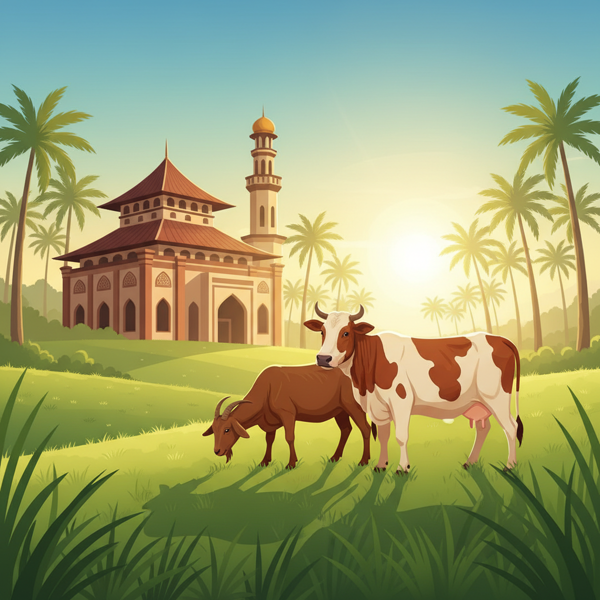
The korban ritual is the most distinctive part of Aidiladha in Malaysia. On the morning of the holiday, after the Aidiladha congregational prayer, an animal (typically a cow, goat, sheep, or sometimes a camel elsewhere) is slaughtered in accordance with Islamic dietary law.
The meat is then divided into three portions:
- One-third for the family of the person performing the sacrifice
- One-third for relatives and friends, often neighbours or those who contributed to the purchase of the animal
- One-third for the poor and needy, distributed to those who wouldn't otherwise have access to meat
In Malaysia, korban is frequently organised collectively. Families pool resources to buy an animal together (especially a cow, which represents seven shares), or they contribute to a mosque's korban programme that handles slaughter and distribution.
Many Malaysian mosques now partner with rural farms, orphanages, or overseas organisations (distributing meat to refugee communities in Gaza, Rohingya in Myanmar, or flood victims elsewhere) to ensure the meat reaches those who need it most.
How Malaysians observe the day
Aidiladha prayer. Early morning. The congregational prayer happens right after sunrise at mosques, open fields, or stadiums. It's noticeably quicker than the regular five daily prayers and incorporates a khutbah (sermon).
Visiting the dead (ziarah kubur). Many families visit the graves of deceased relatives before or after prayers. This is a shared tradition with Aidilfitri.
Korban. Conducted after the prayer and typically throughout the day of Aidiladha and the three following days.
Family meals. Most households roll directly from korban distribution to cooking the meat. Traditional dishes include sup tulang (bone soup), daging masak hitam (black beef stew), gulai kawah (cauldron curry for large gatherings), and nasi minyak.
Open house. Smaller in scale than Aidilfitri, but many families still host friends and relatives for meals over the weekend following.
Aidiladha versus Aidilfitri
A quick comparison of the two Raya days:
| Aspect | Aidilfitri | Aidiladha |
|---|---|---|
| Date (Hijri) | 1 Syawal | 10 Zulhijjah |
| What it commemorates | End of Ramadan | Ibrahim's sacrifice, end of Hajj |
| Public holiday duration | 2 days | 1 day |
| Balik kampung scale | Massive, national traffic event | Moderate, slower pace |
| Main ritual | Takbir Raya, open house | Korban (sacrifice) |
| Attire | New baju raya | Sometimes new, often simpler |
Both are federal public holidays gazetted across all 13 states and 3 federal territories. Aidilfitri gets 2 days of gazetted holiday (1-2 Syawal), while Aidiladha gets 1 (10 Zulhijjah).
Hajj and Aidiladha
Aidiladha falls during the Hajj pilgrimage in Mecca. Hajj is a five-day event that culminates with the stoning of pillars at Mina and the sacrifice ritual, which Malaysian pilgrims replicate at home.
Roughly 30,000 Malaysian pilgrims travel to Mecca for Hajj each year through the Tabung Haji system, a government-linked fund that both administers pilgrimage logistics and accepts long-term savings from aspiring pilgrims. The Tabung Haji scheme is unique to Malaysia and is one of the country's more distinctive Islamic institutions.
Pilgrims returning from Hajj are traditionally greeted with respect and addressed as Haji (for men) or Hajah (for women) for the rest of their lives.
When is Aidiladha 2026?
Hari Raya Aidiladha 2026 is expected to fall on Wednesday, 27 May 2026, subject to moon-sighting announcements from JAKIM.
That Wednesday placement is great for long-weekend planning. Take Thursday and Friday off, and you turn two leave days into a 9-day break (Saturday 23 May through Sunday 31 May). We break this down in our long-weekend guide.
See the May 2026 calendar for the full context, including how Aidiladha sits near Wesak Day (1 May) and Hari Raya Aidilfitri carry-over from March.
Non-Muslims and Aidiladha
Aidiladha is a quieter public holiday than Aidilfitri, but a few things are worth knowing if you're not Muslim:
- Many offices and schools close, so plan accordingly
- If you're invited to an Aidiladha meal, expect a lot of meat dishes, it's the day's central feature
- Traffic is noticeable but not at Aidilfitri levels, expect moderate highway congestion in the 24 hours before and after
- Local cattle prices and beef supply can shift around the period, so if you run a restaurant or butcher shop, plan procurement accordingly
Aidiladha is, in many ways, the Hari Raya that rewards understanding. It's less about festivity and more about the quiet acts of sharing, remembrance, and obedience that sit at the heart of the Islamic year.
For the rest of the 2026 calendar, see the year overview. And for more on how the Hijri calendar drives these dates, read our Hijri calendar guide.