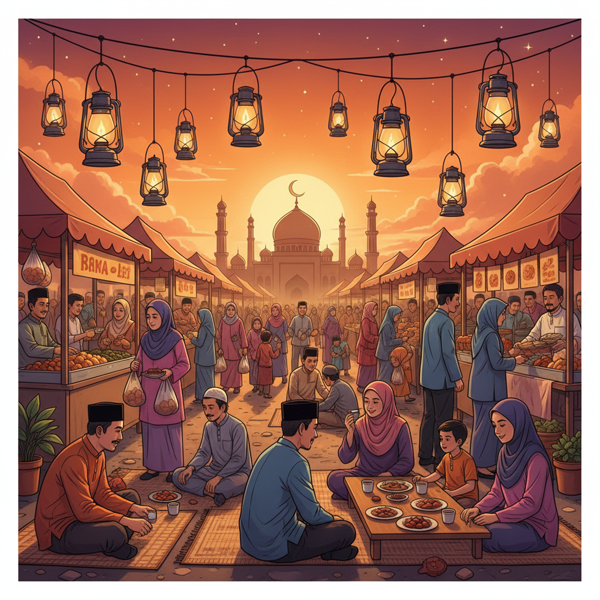
The month the country slows down and speeds up at once
If you visit Malaysia during Ramadan, you'll notice two contradictory things happen in the same week. During the day, streets are quieter. Cafes close or keep shorter hours. Office lunch breaks are shorter (or skipped entirely). And then, around 5pm, the whole country kicks into gear. Bazaar Ramadan stalls fire up their grills. Families drive home with boxes of food. Mosques fill for the first of several nightly prayers.
Ramadan is the ninth month of the Islamic Hijri calendar and the holiest month for Muslims worldwide. In Malaysia, where over 60% of the population is Muslim, its rhythm reshapes daily life for a full 29 or 30 days. Let's walk through what actually happens. For the 2026 Ramadan dates, see the year calendar.
What Ramadan is about
Ramadan commemorates the month in which the Quran was first revealed to Prophet Muhammad. During the month, Muslims observe sawm (fasting) from dawn to sunset as one of the Five Pillars of Islam.
The fast covers more than food and drink. Practising Muslims also refrain from smoking, sexual activity, gossip, and anger during daylight hours. The goal is spiritual refinement, empathy for the poor, and closer attention to one's relationship with God.
Exemptions apply to those who are ill, travelling, pregnant, menstruating, or unable to fast for medical reasons. Missed days are made up later or compensated through fidyah (payment that supports feeding the poor).
The daily rhythm
A typical Ramadan day in Malaysia runs something like this:
Sahur (pre-dawn meal). Usually around 5am. Families eat a full meal before the imsak time (when fasting begins). Sahur dishes tend to be substantial: rice, eggs, sambal, and plenty of water. Some families eat at home, others head to 24-hour mamak stalls that do brisk sahur business.
Fajr prayer. At dawn, Muslims pray the first of the day's five mandatory prayers.
Working day. Offices and schools run as normal but at reduced energy levels. Restaurants serving Muslim clientele mostly close for dine-in but many stay open for takeaway or reopen in the evening.
Asar to Maghrib. The last hour before breaking fast is the busiest of the day. Drive-through queues at Bazaar Ramadan stalls stretch around the block. Highway traffic spikes as people hurry home.
Iftar (breaking fast). At sunset, traditionally with dates and water, followed by a full meal. Many families share iftar together, and mosques often host iftar berjemaah (communal iftar) for community members.
Tarawih prayer. After the Isyak prayer, many Muslims attend the voluntary tarawih prayers at the mosque. These can last 1-2 hours depending on the mosque.
Bazaar Ramadan: the national snack obsession
Bazaar Ramadan are pop-up food markets that appear in every town and neighbourhood for 30 days. They're one of the most beloved Malaysian traditions of the month. Stalls open from mid-afternoon and the busiest hour runs roughly 5-7pm.
Signature items you'll find at almost every bazaar:
| Dish | What it is |
|---|---|
| Ayam percik | Grilled chicken with spiced coconut sauce |
| Murtabak | Thick pancake stuffed with minced meat and egg |
| Nasi kerabu | Blue-tinted rice with herbs, salted egg, and fried fish |
| Popiah basah | Soft spring rolls with jicama and peanut |
| Kuih muih | Assorted traditional sweet bites |
| Apam balik | Fold-over pancake with crushed peanut and sweetcorn |
| Air tebu | Fresh-pressed sugar cane juice |
Bazaars vary by state. Kelantan and Terengganu have the most elaborate traditional offerings. KL and Selangor lean modern fusion (rendang burger, anyone?). Sabah and Sarawak incorporate indigenous flavours. No two bazaars are the same.
The last 10 nights
The final third of Ramadan carries special weight. The last 10 nights are when many Muslims believe Laylatul Qadr (the Night of Power) falls. This is described in the Quran as "better than a thousand months" and is considered the single holiest night of the year.
During these nights, mosques run qiyamulail (late-night prayers) that can extend past 2am. Some devotees undertake i'tikaf, a multi-day spiritual retreat spent inside the mosque. Charitable giving increases, and shopping malls run 24-hour hours in many cities for last-minute Hari Raya preparations.
Balik kampung and traffic
Ramadan culminates in Hari Raya Aidilfitri, marked on 1 Syawal. Most Malaysians travel back to their hometowns (balik kampung) in the final days of Ramadan. Highway traffic in the last three days of the month is the heaviest of the entire year.
If you're driving, leave either very early or very late. The worst congestion runs 3pm to 9pm on the final Friday and Saturday.
Non-Muslims and Ramadan
If you're not Muslim, Ramadan doesn't require anything of you, but there are a few cultural norms worth respecting:
- Avoid eating, drinking, or smoking in front of fasting colleagues during the day (common courtesy, not a legal requirement)
- Office lunch meetings are typically skipped or moved to morning/evening
- Bazaar Ramadan are open to everyone, and many Malaysians from all backgrounds go for the food
- Iftar invitations from Muslim friends are worth accepting, they're one of the warmest hospitality moments of the Malaysian year
When is Ramadan 2026?
Ramadan 2026 is expected to begin around Monday, 17 February 2026, subject to the official JAKIM moon-sighting announcement. The month runs until Hari Raya Aidilfitri on or around 19 March 2026.
Hijri dates can shift by a day depending on moon-sighting results. See our deeper guide to the Hijri calendar to understand why.
Plan your month with the February 2026 calendar and the March 2026 calendar. If you're looking for long-weekend plans around Aidilfitri, our long-weekend guide has strategy.
Ramadan reshapes Malaysia in ways both visible and quiet. Even if you don't observe it yourself, noticing the shift from daytime stillness to evening buzz is one of the most distinctive experiences the Malaysian calendar has to offer.