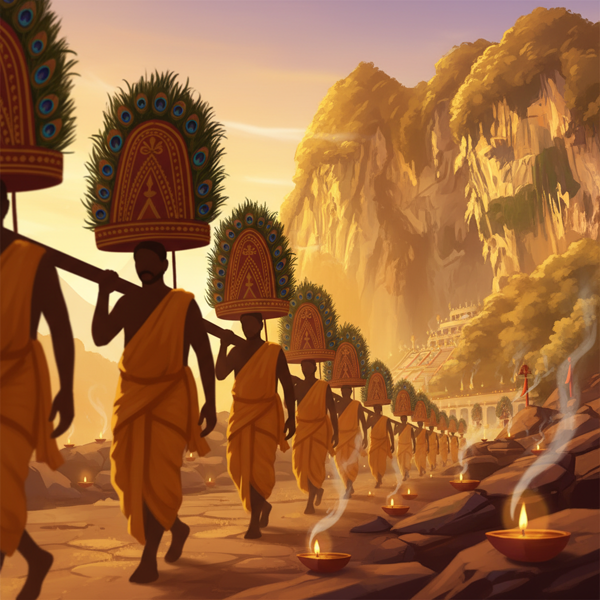
A river of people climbing 272 steps at 4am
If you've ever stood at the foot of Batu Caves on Thaipusam morning, you'll remember the sound before anything else. Drums, bells, chants in Tamil, feet on wet limestone. A million devotees and visitors move through the temple complex over 48 hours, most of them walking the 272 steps barefoot while kavadi bearers pass slowly through the crowd. It's one of the largest Hindu gatherings outside India, and it happens right here in Malaysia.
Thaipusam is a state public holiday in several Malaysian states, but it's not a federal holiday. Whether you get the day off depends on where you live. Before you plan a visit or a day off, it helps to understand what the festival actually commemorates and how it fits into the Malaysian calendar. Check the 2026 calendar to see where the date lands this year.
What Thaipusam commemorates
Thaipusam marks the day the Hindu goddess Parvati gave her son Lord Murugan a divine spear, the vel, to defeat the demon Soorapadman. The festival falls on the full moon in the Tamil month of Thai (January to February), when the star Pusam is at its highest. The name combines both: Thai + Pusam.
For devotees, it's a day of fulfilling vows. Pilgrims who have prayed to Murugan for help through illness, hardship, or family struggles offer thanks in tangible, physical ways. Carrying a kavadi is the most visible, but many simply shave their heads, walk barefoot, or fast for weeks before.
The kavadi: devotion made visible
The word kavadi literally means burden. It takes several forms:
- Paal kudam: a pot of milk carried on the head, the simplest and most common offering
- Kavadi attam: a semi-circular wooden or metal structure decorated with peacock feathers, worn on the shoulders
- Vel kavadi: the dramatic form most people associate with Thaipusam, where devotees pierce their cheeks, tongues, or backs with small spears and hooks, often with no visible bleeding
Devotees prepare for weeks. They follow a strict vegetarian diet, abstain from alcohol, sleep on the floor, and spend time in prayer. On the day itself, many enter a trance state before the piercings, which they describe as painless. Whether you view this through a spiritual or a psychological lens, the dedication is real.
Where to witness Thaipusam in Malaysia
Three locations draw the biggest crowds:
| Location | State | Scale |
|---|---|---|
| Batu Caves | Selangor (technically) / KL area | 1+ million visitors over 2 days |
| Waterfall Temple (Sri Balathandayuthapani) | Penang | 1 million+ |
| Sri Subramaniar Temple | Ipoh, Perak | Several hundred thousand |
Batu Caves is the most famous. The procession traditionally begins the night before at Sri Mahamariamman Temple in downtown KL and arrives at Batu Caves before dawn. The silver chariot carrying Lord Murugan's idol is pulled through the streets by devotees.
Penang's celebration has its own unique character. The chariot procession from Little India to Waterfall Temple is considered one of the most visually striking Thaipusam events in the world. Penang declares its own state holiday for the day, and the city slows noticeably.
Where is it a public holiday?
This is where the state calendar rules matter. Thaipusam is a gazetted public holiday in:
- Kuala Lumpur and Putrajaya (federal territories with significant Hindu populations)
- Selangor, Negeri Sembilan, Perak, Penang, Johor
- Not in other states, where it passes as a normal working day
If you're in Sabah or Sarawak, Thaipusam is not a holiday. But if you're in Kuala Lumpur or Penang, you get the day off along with significant traffic disruptions, especially near temple routes.
When is Thaipusam 2026?
Thaipusam in 2026 falls on 1 February, a Sunday. Because it lands on a Sunday, several states observe a replacement holiday on Monday 2 February. This gives residents in Thaipusam-observing states a natural long weekend.
Replacement-holiday rules vary by state, so always check your state calendar to confirm whether the Monday applies where you live.
Planning around the day
If you're going to Batu Caves:
- Arrive before 5am or after 9pm. Midday is suffocating.
- LRT stations near Batu Caves close earlier than usual due to crowd control. Check Prasarana announcements.
- Roads are closed in stages. Drive only if you know which roundabout to avoid.
- Wear closed shoes for the walk in, then switch if you want to climb the steps barefoot.
If you're not going but live in a Thaipusam area:
- Expect traffic congestion for 48 hours around the temple zones.
- Many Hindu-owned businesses close for the day. Plan grocery runs accordingly.
- Enjoy the long weekend if your state observes it.
Thaipusam, tourism, and respect
Thaipusam draws huge international media attention. It's worth remembering this is first and foremost a religious observance, not a spectacle. Most temples welcome respectful visitors, but photography near kavadi bearers or mid-trance requires sensitivity.
The crowds at Batu Caves include Hindus, Buddhists, Christians, Muslims, and plenty of curious tourists. That's part of what makes Thaipusam distinctly Malaysian. A Hindu festival on this scale, celebrated so publicly, is one of the clearest expressions of the country's plural religious fabric.
For the exact 2026 dates across states, see the February 2026 calendar. And if you're new to how Malaysian state holidays work, start with our guide to federal versus state holidays.