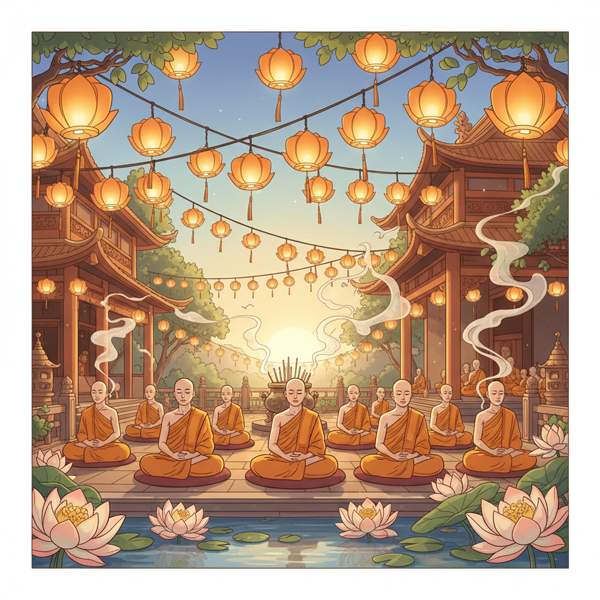
Dawn at a Buddhist temple, incense and lotus lanterns
Walk into any major Buddhist temple in Malaysia before sunrise on Wesak Day and you'll find the same scene. A long queue of devotees carrying lotus-shaped lanterns, bowls of flowers, and containers of oil. Monks in saffron robes conducting chants in Pali. The air thick with sandalwood incense. A few hours later, the same temples host a procession that winds through the surrounding streets.
Wesak Day (also written Vesak) is the holiest day in the Buddhist calendar and a federal public holiday in Malaysia. It's one of those holidays most non-Buddhists know exists but don't necessarily know what it's actually marking. Let's change that. For the exact 2026 date, see the year calendar.
What Wesak commemorates
Wesak is unusual among religious holidays because it commemorates three separate events all believed to have occurred on the same day of the lunar calendar:
- The birth of Siddhartha Gautama, the future Buddha, in Lumbini around 623 BCE
- His enlightenment under the Bodhi tree in Bodh Gaya at age 35
- His parinirvana (passing away) at age 80 in Kushinagar
The name comes from the Pali word Vesākha, the second month of the Indian lunar calendar. Wesak falls on the full moon of that month, which usually lands in May on the Gregorian calendar.
For Buddhists, it's the most significant date of the year. A day to reflect on the Buddha's teachings, perform acts of generosity (dana), and recommit to the precepts of right thought and action.
How Malaysian Buddhists observe the day
Observance varies by tradition. Malaysia has Theravada, Mahayana, and Vajrayana Buddhist communities, and each has its own emphasis. But several practices are near-universal.
Dawn temple visits. Most devotees aim to arrive at the temple before sunrise. Offerings of flowers, candles, and incense are placed at the altar.
Taking the Eight Precepts. Many devotees observe stricter precepts on Wesak, including refraining from food after midday, avoiding entertainment, and wearing simple white clothing.
Bathing the Buddha. A common ritual, especially among Mahayana practitioners, involves ladling water over a small statue of the infant Buddha. This symbolises inner purification.
Dana (almsgiving). Offering food to monks, donating to the temple, distributing food to the poor, or releasing captive animals (though the animal release tradition is increasingly discouraged for ecological reasons).
Candle and lantern processions. The evening procession is often the most visible public part of Wesak. In KL, the biggest draw is the procession starting at the Buddhist Maha Vihara in Brickfields. Thousands of devotees walk alongside floats decorated with Buddhist imagery.
Where is it a public holiday?
Wesak Day is a federal public holiday observed in all 13 states and 3 federal territories. No state opts out. The Selangor calendar and the Sarawak calendar will both show it.
However, the scale of public celebration varies widely by region. KL, Penang, Ipoh, Melaka, and Klang have the largest temple gatherings and most visible processions. Smaller towns with significant Chinese Buddhist communities (Sitiawan, Taiping, Bukit Mertajam) also mark it well.
In Sabah and Sarawak, Wesak is observed but less publicly. In East Malaysia, the local Kadazan-Dusun and Iban communities are predominantly Christian, while the Chinese communities tend to celebrate through their local temples in smaller gatherings.
When is Wesak 2026?
Wesak 2026 falls on Friday, 1 May. Here's the catch: 1 May is also Labour Day, a federal holiday.
That means Wesak 2026 collides with Labour Day, and most observers lose one of the two holidays. In practice, the government gazettes one holiday and workers get a single day off on 1 May. There's no automatic replacement for the overlap.
Check the May 2026 calendar for how the weekend plays out. Friday 1 May plus weekend equals a natural 3-day break, but you miss the extra day you'd normally get when Labour Day and Wesak fell separately.
Wesak processions worth attending
If you want to see the public face of the festival, consider:
| Temple / Procession | Location | Notes |
|---|---|---|
| Buddhist Maha Vihara (Brickfields) | Kuala Lumpur | The largest in Peninsular Malaysia, draws 100,000+ |
| Kek Lok Si | Penang | One of the largest Buddhist temples in SEA, lit up for the evening |
| Sam Poh Tong | Ipoh | Cave temple, smaller but atmospheric |
| Dhammikarama Burmese Temple | Penang | Theravada tradition, quieter, more meditative |
These processions are open to everyone. Respectful dress (shoulders and knees covered), silent observation during chants, and no flash photography are the baseline rules.
Wesak as a multi-religious moment
One thing that strikes visitors about Malaysian Wesak is how non-Buddhist Malaysians often participate quietly. Friends attend processions to support Buddhist peers. Schools sometimes include Wesak lessons in moral education. Newspapers run features on the Buddha's teachings.
This reflects a broader pattern across Malaysian religious holidays. Hari Raya, Deepavali, Christmas, Wesak, and Chinese New Year all have a shared public face. People of all backgrounds show up to their friends' celebrations, eat the food, and learn at least a little about why the day matters.
For the 2026 holiday schedule and how Wesak fits with Labour Day and other May events, see our guide to maximising long weekends. You can also browse the full May 2026 calendar for the complete picture.