"What year were you born?" means something in Malaysia
Ask a Malaysian Chinese uncle at a wedding what year you were born, and he's probably not curious about your age. He's working out your zodiac animal (shengxiao) and, by extension, your general compatibility with the couple, the host, or whoever else he's sizing up at the table. This is the Chinese zodiac in action, and it's woven into Malaysian Chinese life in ways that go well beyond Chinese New Year.
If you've ever wondered why your friend's parents are oddly intense about a particular year, or why certain businesses open on certain dates and not others, the zodiac is usually part of the answer. Let's walk through how it works. For the current zodiac year, see the year calendar.
The basics: 12 animals, 12 years
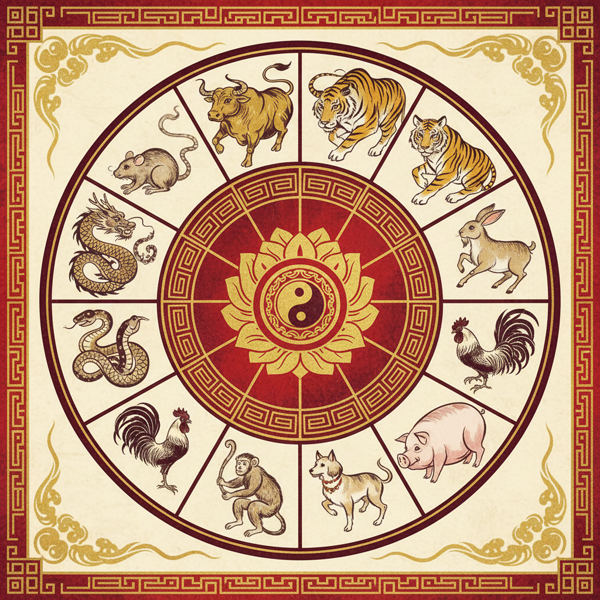
The Chinese zodiac cycle rotates through 12 animal signs, each assigned to a full lunar year. The order is fixed and has been for roughly 2,000 years:
- Rat (鼠)
- Ox (牛)
- Tiger (虎)
- Rabbit (兔)
- Dragon (龍)
- Snake (蛇)
- Horse (馬)
- Goat (羊)
- Monkey (猴)
- Rooster (雞)
- Dog (狗)
- Pig (豬)
Every person born in a given lunar year belongs to that year's animal. A full cycle runs 12 years, so everyone aged exactly 12, 24, 36, 48, 60, or 72 years apart share the same animal sign.
Why the year changes on Chinese New Year, not 1 January
A common point of confusion. The Chinese zodiac year does not start on 1 January. It begins on Chinese New Year, which falls on the new moon between late January and mid-February.
So if you were born on 15 January, 2000, you are technically a Rabbit (1999 year), not a Dragon (2000 year). The switch happened on 5 February 2000.
This matters when checking your zodiac online, since many simplified charts use Gregorian years. For accurate checking, cross-reference with the February 2026 calendar or any month showing Chinese New Year dates. Our article on Chinese New Year 2026: Year of the Horse covers the current cycle in detail.
The five elements
The full Chinese zodiac isn't just animals. Each year is also associated with one of five elements: Wood, Fire, Earth, Metal, and Water. Combined with the animal signs, this produces a 60-year cycle (12 animals times 5 elements = 60 unique combinations).
For 2026, we're in the Fire Horse year (Bing Wu, 丙午). Fire Horse is a dramatic combination, and older generations remember past Fire Horse years (1906, 1966) as particularly eventful.
Elements also shape how each animal expresses its qualities. A Wood Horse (2014) and a Fire Horse (2026) share the same core animal traits but differ in intensity and emphasis.
What each animal is said to bring
Here's a simplified chart of common zodiac associations in Malaysian Chinese tradition. These are folk beliefs, not science, but they shape real decisions around marriages, business partnerships, and major purchases.
| Animal | Common traits |
|---|---|
| Rat | Quick, adaptable, clever, good with money |
| Ox | Steady, reliable, hardworking, stubborn |
| Tiger | Bold, confident, adventurous, impatient |
| Rabbit | Gentle, diplomatic, cautious, reserved |
| Dragon | Ambitious, magnetic, dominant, extroverted |
| Snake | Wise, intuitive, secretive, calculating |
| Horse | Energetic, independent, restless, impulsive |
| Goat | Creative, empathetic, gentle, indecisive |
| Monkey | Witty, inventive, sociable, mischievous |
| Rooster | Observant, punctual, outspoken, critical |
| Dog | Loyal, protective, honest, anxious |
| Pig | Generous, sincere, easy-going, naive |
These are broad tendencies, not predictions. Most Malaysian Chinese today treat them more as cultural touchstones than serious life guidance, though for certain decisions (weddings in particular) the compatibility check is still taken seriously by older generations.
The zodiac in everyday Malaysian life
You'll see the zodiac show up in:
Business dates. Some business owners (especially older Chinese entrepreneurs) consult a tong sheng (almanac) for auspicious dates to open a new shop, sign a major contract, or launch a product. The zodiac compatibility between the business owner's year and the candidate date matters.
Weddings. Matchmaking traditionally considers both partners' zodiac signs. Certain pairs (Ox-Goat, Rat-Horse, Tiger-Monkey) are thought incompatible, though modern couples increasingly ignore this.
Births. Dragon years see measurable spikes in births across Malaysia and other Chinese-majority communities. Dragons are considered the most auspicious sign, and families time pregnancies accordingly. The next Dragon year is 2024, and KL hospitals reported a noticeable uptick.
Feng shui. Year-end feng shui readings for the coming year always reference the incoming zodiac sign and element.
Chinese New Year decorations. The year's zodiac animal appears on red packets (ang pao), couplets, bakery boxes, and shopping-mall decorations throughout the festival period.
The "zodiac year" or ben ming nian
Here's a quirk that throws a lot of people: your own zodiac year is traditionally considered unlucky. This is called ben ming nian (本命年), or "year of birth sign."
The belief is that you clash with the Grand Jupiter (Tai Sui) in your own year, attracting misfortune. Traditional countermeasures include:
- Wearing red underwear throughout the year (common even among people who don't believe strongly)
- Donating to charity
- Avoiding big life changes (moving, marrying, launching businesses)
For 2026, people born in Horse years (1930, 1942, 1954, 1966, 1978, 1990, 2002, 2014) are entering their ben ming nian. Check Chinese bookshops in Petaling Street or any major mall, ben ming nian merchandise (red underwear, jade charms) is everywhere.
How the zodiac interacts with the Chinese calendar
The Chinese zodiac is part of the lunisolar calendar used for Chinese New Year and other traditional dates. This calendar tracks both moon phases (for months) and the solar year (for seasons), producing a system where the new year shifts each Gregorian year.
We've written a deeper look at how the Chinese calendar shapes Malaysian life in our Chinese New Year 2026 article. The zodiac and the calendar are inseparable. You can't really understand one without the other.
Should non-Chinese Malaysians care?
Maybe a little. The Chinese zodiac is a shared cultural touchstone in Malaysia, and knowing your own sign helps you participate in conversations during Chinese New Year season. It also comes up surprisingly often in business and social contexts, especially with older Chinese colleagues.
You don't need to believe any of it to find the cycle interesting. It's a 2,000-year-old system still shaping decisions in a modern Southeast Asian country, which is its own kind of remarkable.
For the current 2026 calendar and all Chinese New Year dates, see the year calendar. For more on the Chinese lunisolar system and how it shapes Malaysian holidays, start with our Chinese New Year guide.