The week East Malaysia takes for itself
Ask anyone in the Peninsula about the first week of June and they'll probably mention the Agong's Birthday long weekend. Ask the same question in Kota Kinabalu or Kuching, and the answer is completely different: Pesta Kaamatan in Sabah (30-31 May), Hari Gawai in Sarawak (1-2 June), both rolling straight into the Agong's Birthday weekend.
For East Malaysia, this is the most important stretch on the calendar. For Peninsula residents, it's often an overlooked chapter of the Malaysian year. Let's walk through what these harvest festivals actually are, why they matter, and how to experience them if you're travelling to East Malaysia. For the 2026 dates, see the year calendar.
The shared root: rice harvest
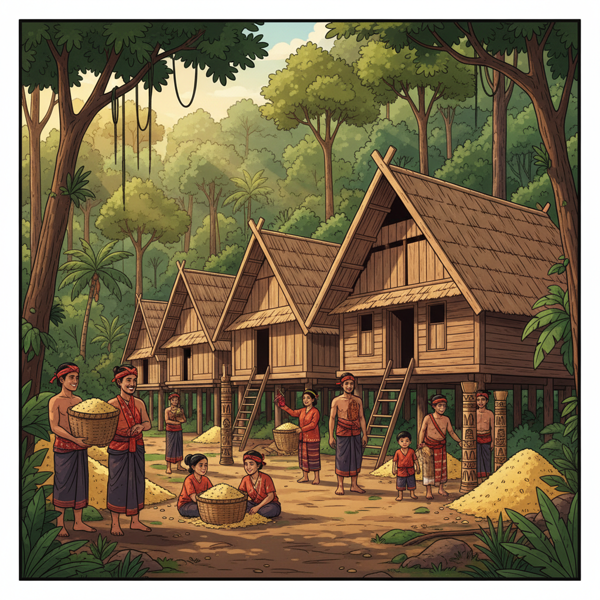
Both Kaamatan and Gawai originate in the same cyclical moment. The end of the padi (rice) harvest. For the Kadazan-Dusun peoples of Sabah and the Dayak (Iban, Bidayuh, Orang Ulu) peoples of Sarawak, rice isn't just food. It's the centre of agricultural life, spiritual belief, and social calendar.
The harvest festival is a thanksgiving to the rice spirit for a successful yield, a reaffirmation of community ties, and the symbolic start of a new agricultural year. Both festivals have pre-Christian animist origins and have evolved alongside the Christian majority in both states, producing a uniquely layered observance.
Pesta Kaamatan in Sabah
Pesta Kaamatan is celebrated from 30 to 31 May every year as a state public holiday in Sabah and Labuan. It's primarily associated with the Kadazan-Dusun and Murut communities, who make up roughly 40% of Sabah's population.
Central to Kaamatan is the Unduk Ngadau beauty pageant, a state-wide competition held at the Kadazan-Dusun Cultural Association headquarters in Penampang. The winner represents Huminodun, the legendary maiden in Kadazan-Dusun mythology who sacrificed herself so rice could grow.
Other Kaamatan traditions:
- Magavau ritual: a ceremonial calling of the rice spirit home, performed by the bobohizan (traditional priestess)
- Sumazau dance: the elegant, bird-like traditional dance of the Kadazan-Dusun people
- Tapai and lihing: traditional rice wines, brewed for months, served at every Kaamatan gathering
- Pinasakan and hinava: traditional Sabahan dishes, including raw fish cured in lime juice
Most Sabahan villages host open houses for Kaamatan, and you don't need to be Kadazan-Dusun to attend. If you happen to be in Sabah for the festival, expect warm welcomes everywhere.
Hari Gawai in Sarawak
Hari Gawai is celebrated on 1-2 June every year as a state public holiday in Sarawak. It's the main festival of the Dayak peoples, especially the Iban, Bidayuh, and Orang Ulu communities, who together make up more than 40% of Sarawak's population.
The festival was first officially gazetted as a holiday on 1 June 1965, making it a relatively recent addition to the Malaysian calendar but a very old observance in practice.
Gawai traditions include:
- Miring ceremony: offerings placed on bamboo stands for the spirits
- Ngajat dance: the warrior dance of the Iban, performed at every longhouse visit
- Tuak: the ubiquitous rice wine, essential to any Gawai welcome
- Gawai Dayak open house: longhouses (and city apartments) welcome visitors across ethnic lines
The longhouse visit is the core of Sarawak Gawai. Iban and Bidayuh longhouses in the interior reopen their doors. A typical visit involves climbing a wooden staircase, being greeted with tuak in a shot glass, dancing ngajat, and eating your way through dishes like manok pansoh (chicken cooked in bamboo) and pandan rice.
Key dates and how they stack
| Festival | Dates (2026) | Where it's a holiday |
|---|---|---|
| Pesta Kaamatan | 30-31 May | Sabah, Labuan |
| Hari Gawai | 1-2 June | Sarawak |
| Agong's Birthday | 6 June | Federal (everywhere) |
Notice how these dates stack tightly. Sabahans and Sarawakians effectively get a week of rolling celebrations, with the Agong's Birthday as a federal cherry on top. If you're planning a trip from the Peninsula, this is arguably the best single week to be in East Malaysia.
How these festivals became public holidays
Both Kaamatan and Gawai are state public holidays only, not federal. The federal government does not gazette them across Peninsular Malaysia.
This is part of a longer story about East Malaysian identity. When Sabah and Sarawak joined Malaysia in 1963 (see our guide on Hari Kebangsaan vs Hari Malaysia), part of the agreement preserved state-level autonomy over culture, religion, and land. The ability to gazette their own harvest festivals as major public holidays reflects that autonomy.
For Sabahans and Sarawakians, Kaamatan and Gawai are more than cultural events. They are affirmations of East Malaysian identity within a federation that can feel Peninsula-centric.
Planning a visit
Getting there. Kota Kinabalu (for Sabah) and Kuching (for Sarawak) are both well-served by direct flights from KL, Singapore, and regional hubs. Book 6-8 weeks ahead for the Kaamatan/Gawai period. Prices climb and seats sell out.
Where to go. In Sabah, the Penampang area hosts the main state-level Kaamatan events, including the Unduk Ngadau finals. In Sarawak, Kuching is the centre of urban Gawai, but the most traditional experience is an overnight longhouse stay in the interior, accessible from Kuching or Sibu by road and boat.
Open-house etiquette. Bring a small gift for the hosts (groceries are fine, or a bottle of something non-alcoholic if the household is Muslim). Don't refuse tuak without a polite explanation. Remove shoes when entering homes. Greet elders first.
Language. English works in urban centres. In longhouses, basic Malay helps. If you pick up a few words of Iban, Bidayuh, or Kadazan-Dusun, you'll earn goodwill immediately.
Why this matters even if you're not going
Even if you don't travel to East Malaysia for Kaamatan or Gawai, the festivals are worth knowing about. They reveal a dimension of Malaysian national identity that rarely features in Peninsula-centric media. They remind us that the Malaysian federation is genuinely plural, with two large states whose cultural clock runs on a different rhythm.
The next time you see a colleague from Sabah or Sarawak heading home in late May, now you know why. Gawai or Kaamatan is waiting.
For the broader May and June 2026 calendar, see the May 2026 calendar and June 2026 calendar.